A week ago I started writing about Bible journaling. Today let’s consider Bible Journaling as Lectio Divina. In Bible Journaling in the New Year I found this definition of lectio divina to share, “Lectio Divina is simply the classical monastic practice of the prayerful reading of the Bible…” It does not treat Scripture as texts to be studied, but as the Living Word.”” (Opening to God: Lectio Divina and Life as Prayer

Bible Journaling as Lectio Divina
I loved this example from Tim Gray’s book
And before all that lovely-dovey stuff makes you feel guilty because you surely don’t feel that way about reading your Bible, did you check out my post the other day, Bible Quotes About God’s Word, where I admitted sometimes reading my Bible seemed like a penance? Yes, I said that. In those times though, I ask God for the desire to read His Word and I know He not only hears that prayer, but honors it as well.

So how does my new found attempts at Bible journaling work within the confines of lectio divina? Extremely well! I sit down and read the text, the assigned reading for the day from our Read the Bible in a Year plan. As I read it, I read it with an open heart and mind, waiting for a certain passage to stand out to me. A verse or even just a word that makes me stop and go back to re-read it. Lectio.
As I roll that verse, passage or word around in my mind, I am meditating. Meditatio. Tim Gray
As I’m meditating, I must keep in mind, all Scripture affirms the teachings of the Church and the teachings of the Church are in agreement with the Scriptures. If my meditation begins to lead me down a path away from the Church, I have misinterpreted the passage.
During our lectio or meditatio, our heart might be stirred by one particular observation. Stop there. Don’t just continue on to the next thing. Take time to go deeper and let the Holy Spirit move your meditatio to the next stage of your journey through lectio divina.
—Praying Scripture for a Change: An Introduction to Lectio Divina
Remember when the other day when I encouraged us to not beat ourselves up if we didn’t finish a book on a list in the appointed time. (The Spirit of Perfection) This is one of the reasons why. It is much more fruitful to take time to listen to the Father admonish, teach or affirm us in His Word than to say we marked off Day 9…on Day 9.
I’ve decided for this year, I will not get behind in my Bible reading schedule. If I miss Day 10 on January 10th, I’m just going to pick up where I am supposed to be on January 11th. If I have time I can go back, but I decided I’m always going to be right on track day to day. This will eliminate any feelings of being behind…maybe even too far behind that I just give the whole thing up.
Next on to prayer–oratio. Prayer is a conversation with God. Speak to Him. You can speak to Him in writing, out loud or in the quiet of your heart, but just start a conversation. And again, how does this ancient practice of lectio divina work well with the seemingly new practice of Bible journaling?
The monks who practiced lectio divina carefully recorded in their personal notebooks or journals the key verses that struck them in prayer or liturgy. Like a honeybee collecting nectar, they would gather these precious Scripture passages for further meditation. As the monks did this they came up with a further practical insight, they realized it helped to write down, slowly, these precious Scripture passages that spoke to them, so that they could be etched into their hearts.
—Praying Scripture for a Change: An Introduction to Lectio Divina
When I read that passage today in Matthew 5 about being salt and light, those words gave me pause. What does that mean for me and to me, to be salt and light. Instead of slowly writing the phrase, I found a pretty little girl to trace and framed her with the phrase. Either way, I spent time with those words.

And finally contemplation–contemplatio. Jacques Philippe states, “Contemplation comes from a deeply personal contact with God, and that is why method is the least useful at the point where prayer is the most personal.” Do you know what that means?! We can’t “do it wrong!” On the other hand, it also means for someone like me, there is not a “do this, then this, next that…” printable.
The author Tim Gray
How awesome that this practice of lectio divina will also be a practice of letting go, trusting that God will hear me, love me and respond to me not because of what I am doing but because of Who He is.
Resources:
The NRSV Notetaker’s Bible


More posts on how I’m using my journaling Bible:
Bible Journaling in the New Year
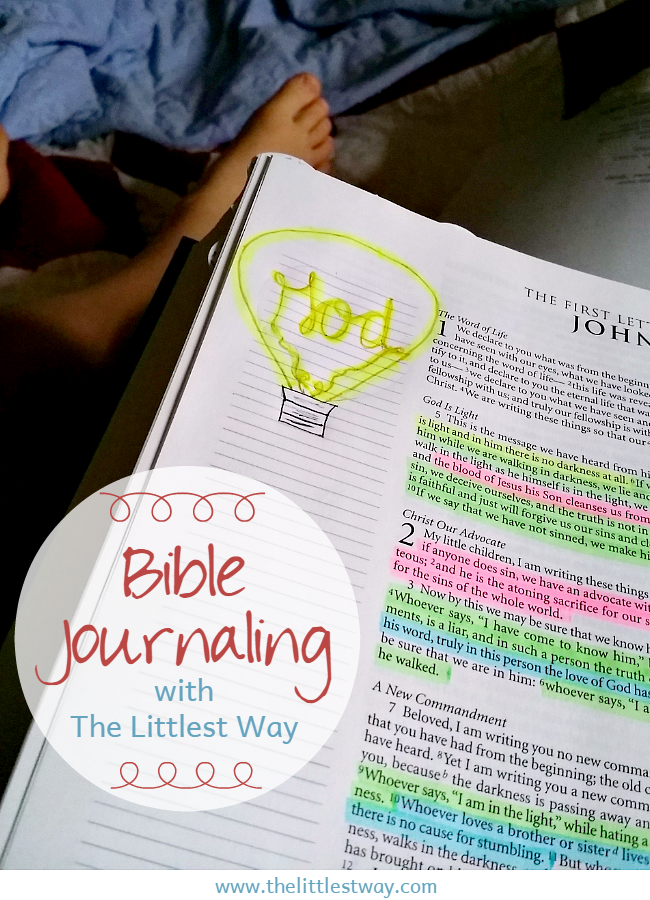
Bible Journaling with The Littlest Way
Bible Journaling and Bible Study
Bible Journaling: Favorites Tabs
I received the book mentioned free for an honest review. All opinions are my own.

 . And one of the notes today reminded me of the importance of reading my Bible. One of today’s readings, following our




 way will be worth it in more ways than just losing almost 25 pounds in 2014.




 .